
Chess is an ancient game, rooted in strategic thinking and Medieval social stratification, which has a reputation for being difficult to master but has a solid foundation on which beginner players can build their skills off of. Of course, the best place for any chess novice to start is with learning about the chess pieces themselves. Once you familiarize yourself with all of the chess pieces' names and their moves, you'll be on a speeding train towards becoming a grandmaster yourself.
Contemporary Chess Pieces

Chess is performed on a standard chessboard and comes with two complete sets of pieces; one for each opponent. Basic sets include one black set and one white set, but the sets can come in any color or design. Yet, even the most stylized sets favor the contrasting dark and light color scheme to differentiate the sides.
Within these sets, each player will have sixteen individual pieces, comprised of:
- (8) Pawns
- (2) Rooks
- (2) Knights
- (2) Bishops
- (1) Queen
- (1) King
How Chess Pieces Move Around the Board
Every chess piece has its own unique set of rules and regulations for what type of movements it's permitted to make. Combine these movements together in a strategic fashion, and you'll be able to dominate the center of the board and win the game:
- Pawns - Aside from the opening move, pawns can only move one space forward per turn. In terms of capturing, pawns are permitted to move one space forward diagonally to capture an opponent's piece.
- Rooks - Rooks are allowed to move any number of vacant spaces in any direction except for diagonally.
- Knights - Knights' movements are iconic because of their weird patterning; they can move in an 'L' shape in a 2-1 or 1-2 fashion. Simply put, Knights can move either two spaces in any direction--save for diagonally--and then one space in any cardinal direction or one space in any direction--save diagonally--and then two spaces in any cardinal direction. They're also permitted to jump over occupied squares so long as it ends in a capture or on a vacant square.
- Bishops - Bishops can move any number of vacant squares diagonally on whichever color that they start out on.
- Queens - Queens are thought of as one of the most powerful pieces on the board thanks to their movement capabilities; they can move any number of vacant squares in any direction, including diagonally.
- Kings - With movements that are much more limited in scope, the King is simultaneously the most valuable and one of the weakest pieces on a chess board. Kings can move one vacant square in any direction, including diagonally.
How Chess Pieces Are Positioned
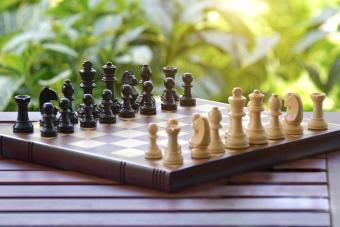
Thankfully, chess is a highly regimented game, meaning that there's an incredibly specific way to set-up your chess board. Each opponent places their pieces on the first two rows closest to them (with the innermost left corner being a dark square). The row closest to them places the rooks at either corner, either knight beside these rooks, and bishops beside the knights. The King takes the remaining square on the left and the Queen on the right. Pawns are then placed, one to every square, across the entire next row.
Once your opponent has completed the very same set-up, your board is ready to go.
Special Moves to Know
Of course, there's a mind-boggling number of different combinations of movements and sequences that these sixteen pieces on a chess board can be moved around to attack and defend. Some pieces have a reputation as serving a sacrificial role, while others are seen as fantastic defenders. However, this view is reductive, as any piece, when expertly wielded, can accomplish just about any task on the board that's required of it.
However, you should familiarize yourself with a few of the special moves that these pieces can complete so that you won't be caught unawares during your next match.
Pawn's Two-Move Opening
Although this wasn't always the case for historic chess, pawns are permitted to move forward two spaces in the opening move of the game. In doing so, multi-day chess games were shortened to a few hours long, and the tradition has fostered a richly complex sector of chess theory dedicated to outlining these movement combinations to develop.
Pawn Promotion
Pawn promotion refers to a unique situation where a pawn reaches the end row of the board furthest from its starting point. Once the pawn reaches that final row, it's allowed to be swapped out with another piece of the player's choosing who moved the pawn belongs to. This can be particularly helpful if a player is running low on pieces and needs to supplement the board with a piece that can move more freely.
Castling
Castling is a move which can be made by the king, where the king moves two squares toward the player's own rook. The rook is then moved into the vacant square the king originally moved through.
This move can only be done under a certain set of circumstances.
- Neither the king nor rook have yet been moved out of their home rank.
- There is no other piece between them.
- The vacant square the king moves through on its way to the rook cannot be under attack by the opposing player.
- The king is not currently in check, nor will be it once the move is completed.
Test Your Newfound Knowledge
While chess has long been referred to as the game of kings and has quite the reputation for being exclusively an aristocratic sport, anyone can learn how to play it. A great place to start learning about the game is to memorize how each piece moves and interacts with each other. Once you understand how these pieces work together as a team, and not just as individuals, you can move onto chess strategy and get yourself one step closer to grandmaster.


