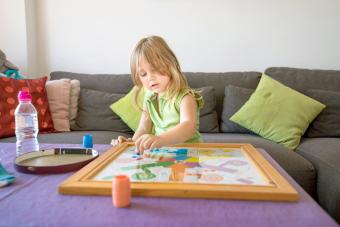
Parcheesi is a fun board game for the entire family, but before you play you'll need to understand the rules. Parcheesi rules are simple and easy to learn. The classic game is a family favorite suitable for ages 6 and up.
Parcheesi Rules Are Simple
Parcheesi is basically a race between two to four players who need to move their pawn pieces around the board and finish at its center. Each player has four pawns. The board game starts with each player's pawns in their home circle to the right.
How to Get Pawns on Board
During each turn, the player needs to move their pawns around the board. How you move your pawns depends on where you are in the game.
Getting Pawns Into Play
You need to roll a 5 to move one of your pawns to the starting point of the mainboard.
- This can be a 5 on one of the dice or a combination of the two dice together.
- For example, if you have a 5 on one die and a 3 on the other, you can move one pawn out, then move it again three spaces in a counter-clockwise direction.
- You can move out two pawns if you have a 5 on both dice.
Get All Pawns on the Board
Getting all your pawns onto the board trumps moving the ones on the board forward.
- If you have pawns remaining to add to the board and roll a 5, you must move the next pawn onto the board rather than moving those already placed.
- If you have a pawn that needs to be on the board, but the starting area to add them is blocked by an opponent's pawn, you will lose your turn.
Moving Pawns in Play
Once your pawn(s) have been put into play, each dice roll can be used to move pawns strategically around the board in a counter-clockwise direction.
- You are not limited to moving just one pawn. You can move two of them with the number that appears on each individual die. If you roll a 6 on one die and 2 on the other, one pawn can be moved a total of eight spaces, or one pawn can move six spaces, and one can move two.
- You cannot split the amount of the die, so in the previous example, you would not be able to move one die three spaces (half of 6) and the other die five spaces (2 plus the 3 from the rolled 6).
Rolling Doubles
If you roll a double, the number moved is determined by the top of the dice that is showing as well as the number at the bottom of the dice.
- If you roll double 1's, you can move two pieces one space, and two pieces six spaces (or you can just move one piece the 14 spaces).
- A double roll also allows you to roll again. If you roll doubles a second time, the rule above applies.
- If doubles are rolled three times in a row, you will have to move the pawn closest to the finish line back to the home circle. This is called a doublets penalty.
How to Capture and Block Opponents in Parcheesi
Here are some helpful hints and tips to win Parcheesi. The goal is to slow down your opponent's move toward the home area.

Parcheesi Rules Capturing
During gameplay, an opponent can capture another player's pawn.
- Blue spaces are safe spaces where pawns cannot be captured unless your opponent is currently on your blue starting space and you need to move your pawn onto the board. In this case, you will capture that pawn.
- If your opponent is on a cream-colored space and you roll a die that will put you onto that space, then you capture the pawn, and the pawn will be taken off the board and must start again. This is known as bopping or a "bop."
- In a variation on this rule, you can also move your piece 20 spaces from the space you just moved your opponent's pawn off.
- The red area to the left of your starting blue area is also a safe area because you cannot move onto an opponent's red path, and they cannot move onto yours.
Blockades in Parcheesi
Blockades are an effective strategy to hinder an opponent. Blockades are formed when two pieces of the same color are on a cream or blue space. A new pawn, your own or an opponent's, cannot be placed on this space and cannot move past it. One can only move past the space when a pawn on the space moves off of it.
How to Enter Home
After a pawn has completed its journey around the board, it is moved towards the center by its home row (which is the one that matches your pawns).
- The pawns can only get to the center through the middle row by an exact count. In other words, a single die or a combination of the two dice must equal the number of spaces needed to get into the center.
- After a pawn reaches the center, you can move another one of your pawn pieces ten spaces.
How to Win Parcheesi
If you have followed all the Parcheesi game rules and moved all of your pawns to the center of the board, you win!! Congratulations!!
Learn More About Parcheesi
Parcheesi is considered the national game of India. Today, the board game is produced by Parker Bros and is a family favorite that's easy and fun to master.


